
It's all about the Benjamins, baby
🛠️ Toolkit: framework for salary negotiations


Welcome to Afternoon Coffee with Jacques, a cozy corner of the internet where Human Design meets modern leadership. Grab your mugs and let's jump in!
Last week I received this text from a client: “My boss is encouraging me to talk to the department head about my salary ASAP. I don’t think the convo is going to go so well.”
Let’s call this client Nikki (name changed for privacy).
She’s a senior exec, well-liked, and like all of my clients, working hard af. She’s a striver.
But despite her solid performance, her company has been slow to increase her compensation, and even slower in promoting her to the next level. It’s been happening, but at a glacial pace.
New employee, who dis: after this urgent nudging from her manager, she wanted to set up a convo with her department head but felt unsure about how to best approach the conversation.
So she reached out to me and we scheduled a 20-minute just-in-time coaching session the very next day.
🆘 Just-in-time coaching session? Think of it as an emergency coaching SOS. My 3- and 6-month programs include biweekly 60-minute sessions, plus 20 minutes per week of just-in-time coaching when something time-sensitive pops up and they need support asap.
For ex, past clients have used these sessions to:
discuss performance reviews
refine pitch decks
prepare for interviews or conversations with key stakeholders
analyze job offers
etc etc
They choose the adventure and I show up ready to support however I can.
During our session, I walked Nikki through my V.E.B. Framework, which is a handy checklist I created specifically for salary negotiations.
The V.E.B. Framework is based on my experience at my last two startups where I got to see both sides of compensation negotiations. First, I supported management in finalizing executive comp packages (at one company, I was basically the HR department for several months). Then I used all that insider knowledge to negotiate my own raises and promotions.
Because once you know how the sausage gets made, you can’t unknow it. So I started coming in guns blazing to these comp convos. 🔫🔫🤠
I’ve refined this framework over the years; with clients and high performers in my network.
As we head toward the end of the year, my assumption is that many of you are also preparing for your own comp conversations, so I thought sharing this framework publicly could be helpful.
I’ve included the framework below. Hit reply with any questions.
I hope this helps secure the bag! 🤑
Value • Expansion • Benefits
The V.E.B. Framework centers on demonstrating and articulating three core things:
the value you’ve provided to the company
the expansion of your scope over the past year (if any)
the full benefits package you’re asking for (salary is just one component)
Let’s break this down:
V - VALUE DELIVERED

Full stop, this is the most important component.
Hard Truth: Companies often don’t care about your seniority or what your coworker makes. Arguments like “I’ve been here for 5 years” or “Jim Bob makes $XYZ” sometimes falls flat.
You know what companies do care about? Making money. The most bulletproof way to approach your salary conversation is by building a business case.
Corporations literally have a fiduciary duty to maximize shareholder returns so lean into that and speak their language. Because at the end of the day this is business.
Key question to consider: What measurable impact have you delivered over the last year?
You can show them your impact two ways: quantitatively and qualitatively:
Quantitative (The Numbers)
Why this matters: Numbers are undeniable. They show concrete ROI and make it harder for leadership to dismiss your contributions. When you can tie your work directly to key business metrics (e.g., revenue, savings, growth, etc.) you’re speaking the language executives understand.
Every business is different, but here are some example metrics you can highlight:
Revenue generated, increased, or protected
Cost savings or efficiency gains
Growth metrics (users, clients, market share)
Time saved (for team, leadership, operations)
Risk mitigated (compliance, legal, operational)
Key Language: “I contributed to...”, “I drove...”, “I delivered...”
Examples:
In the past year, I generated $10m in incremental revenue
In 2025, my [new process] saved the company $100K in fees
Qualitative (The Intangibles)
These are the contributions that don’t show up on a spreadsheet but absolutely move the needle. For example: mentorship, cultural impact, innovation, collaboration, reputation building, etc.
Why this matters: Not everything can be quantified, but that doesn’t make it less valuable. Qualitative impact shows the ripple effects of your work. These contributions build long-term value and are often what actually separate top performers from the rest. Don’t sleep on this section.
Examples you could highlight:
Leadership abilities contributing to cultural impact and team morale
Mentorship and knowledge transfer
Cross-functional collaboration improvements
Innovation in processes or approaches
Reputation enhancement (internal/external)
Feedback from leadership, peers, clients
Key Language: “I strengthened...”, “I led...”, “I improved...”
Examples:
I mentored two new team members and served as committee member for the Women’s ERG
These partners celebrated my work by saying… if you can include screenshots or quotes from those partners, include them! Make that sh** undeniable.
E - EXPANSION OF SCOPE

This is where you demonstrate you’re already operating at the next level - whether that’s formal or informal. This section won’t apply every year, but when it does, it’s powerful.
Here’s the reality: too often, we’re already doing the work of the next promotion without the title or the pay. So make that case explicitly.
Key question to consider: How are you performing beyond your original role?
Where to look for expansion:
Deepening: Taking on more complex, strategic work
Broadening: Contributing across departments or new business areas
Innovation: Introducing new ideas, processes, or initiatives
Leadership: Formal or informal leadership responsibilities (even without direct reports)
Strategic Thinking: Moving from execution to strategy and vision
Key Language: “I’ve expanded my impact by...”, “I’ve taken ownership of...”, “I’ve pioneered...”
Critical Distinction: This isn’t just “doing more work” - it’s demonstrating how your role has evolved and why your current compensation no longer reflects your actual contribution.
Examples:
My idea to expand to this new line of business resulted in…
I’m managing [people, processes, etc], which is an expansion of my role
B - BEYOND SALARY
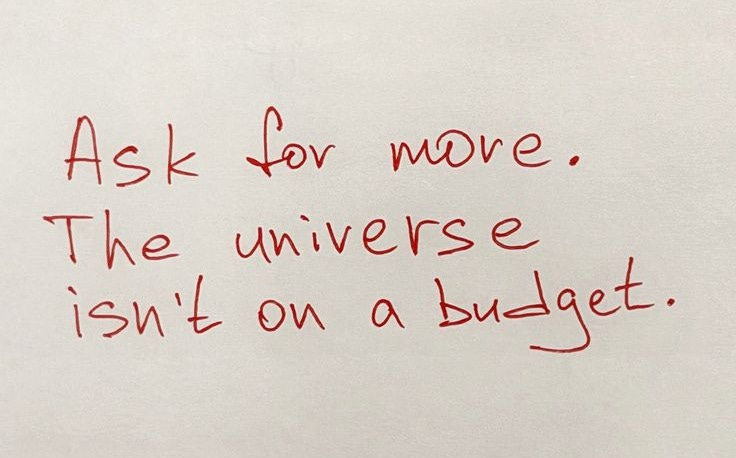
Your base salary is just one part of your compensation - it’s the most visible, but it’s not the only component.
There are multiple levers you can pull beyond salary, and some may be easier for your company to approve than a straight base increase. Thinking holistically gives you more leverage and more ways to get what you want.
Key question to consider: What’s the full compensation package you’re seeking?
What all can you ask for?
Base salary increase (your anchor)
Title change/promotion
Bonuses
Equity/stock options
Additional PTO
Healthcare upgrades
Education/professional development budget
Executive coaching stipend (holla at your girl!)
Flexible work arrangements
If something isn’t listed, hit reply so I can share with this community!
How you could approach this strategically:
Know your priorities (what matters most to you?)
Create tiers (must-haves vs. nice-to-haves)
Build in trade-offs (if not X, then Y)
How you could structure this conversation
1. Start with VALUE
Lead with 2-3 quantitative achievements
Follow with 1-2 qualitative impacts
Connect each to business priorities
2. Highlight EXPANSION
Outline 2-3 ways your scope has grown (if applicable)
Show how you’re operating beyond your current level
Demonstrate future trajectory
3. Outline ideal BENEFITS
State your compensation expectations clearly
Present as a package, not just salary
Be specific with numbers/percentages
My two cents: I recommend not mentioning:
❌ Personal financial circumstances
❌ Personal life changes (mortgage, family, etc.)
❌ What you “need” to make
❌ Comparisons to peers based on gossip
❌ Threats or ultimatums (unless you’re genuinely prepared to leave)
Why? Your compensation should reflect your value to the business, not your personal situation. Keep the conversation professional and business-focused.
Disagree or have questions? Let me know in the comments! 👇🏾
Getting together IRL

In search of a reset? We’re down to our last spots for the upcoming ‘Return to You Retreat’ in Mexico. If you’re looking for space to unplug by the ocean, be pampered, and connect with other amazing women, this experience is for you!
Retreat deets:
Dates: January 15-20, 2026 (MLK Weekend)
Airport: Cancun Intl (the villa is ~1 hour away)
Rooms Available: Penthouse suite and shared room with Queen bed
Reserve: your spot by hitting reply!
Check out the magic below:
Seeking clarity going into the new year? For a limited time, I’m opening up 60-minute coaching intensives - something I typically reserve for existing clients only. Perfect if you want a co-pilot to:
strategize your next move
prep for a big conversation
go deep on your Human Design
work through a specific challenge
Not ready for a 3- or 6-month commitment? This is your chance to get targeted coaching without the full program investment. It’s also a great way to experience my coaching style if you’ve been curious 😉
Book your sessions here.
Here’s to our rising! 🐦🔥
Thank you for reading and contributing to this community. If you found this post insightful, I invite you to like this post or forward it to a friend.
New posts arrive every other Saturday. You can browse the complete archive here, and I invite you to connect with me on Instagram or LinkedIn.
With love until next time,
Jacques